How to Identify Your Hair Texture and Curl Pattern
Fine hair
Fine hair lacks volume, but is relatively easy to style. Hairstylist and Virtue ambassador Kindale Godbee says there’s separation and frizz when fine hair lacks moisture, or when no product is present.
What to use: One of the easiest ways to swell the cuticle is with thickening ingredients that make the hair appear thick, like saw palmetto berry, which can be found in R + Co Dallas Biotin Thickening Shampoo. It’s also rich in pro-vitamin B5 for deep hydration, natural-looking shine, and volume.
Medium hair
Godbee says medium hair can be overwhelming to tame or style, but is more resistant to breakage. Lin also recommends taking extra good care of the cuticle so color doesn’t fade as quickly.
What to use: To maintain the health and color of medium hair, load up on serums that protect its color while lightly conditioning it—Color Wow Dream Coat Supernatural Spray is a favorite. Plus, it works wonders at repelling humidity.
Thick hair
Thick hair is hard to manage and comes with its own set of problems like snarls and tangles, constant frizz, and the fact that it takes forever to dry.
What to use: Thick hair experiences frizz, so a smoothing cream, like Alterna Caviar Anti-Aging Smoothing Anti-Frizz Blowout Butter, is imperative. This product adds shine while keeping hair soft and manageable with camellia and avocado oils, so dryness is never an issue.
Coarse hair
Coarse hair loses moisture, rendering it dry and brittle. But, Du says coarse hair textures do well with smoothing creams, serums, and dry oils to tame rogue flyaways.
What to use: Different from a deep conditioner, Alterna Caviar Anti-Aging Restructuring Bond Repair Leave-in Protein Cream infuses coarse hair with much-needed proteins and omega acids to increase hydration levels, elasticity, and shine.
Oily hair
Excess oil builds up at the roots making hair look and feel weighted and dirty and leading to dry scalp and dandruff. “Oily hair occurs due to pH imbalances on the scalp, but charcoal shampoos and conditioners can help control it,” Du says.
What to use: Charcoal is the star ingredient in Briogeo Scalp Revival Charcoal Coconut Oil Micro-Exfoliating Shampoo, alongside plant-based exfoliators, to remove follicle-clogging oil. Plus, less oil on the scalp means less irritation and itchiness.
Normal hair
With the right balance of oil and dryness, normal hair may have fewer requirements than other hair types, but it’s just as privy to environmental damage, which can wreak havoc on strands.
What to use: Protect hair from the elements with a weightless protecting mist, like Oribe Invisible Defense Universal Protection Spray. It leaves an invisible layer of defense on the hair to shield it from oxidative stress, photoaging, and the drying effects of weather, too.
Dry hair
Dry hair symptoms directly relate to the amount of it sustains. “In general, heat damage and dehydration cause dry hair, which is more prone to static and dead ends,” says Lin.
What to use: For a dose of deep hydration, reach for Virtue Healing Oil. This lightweight serum works within seconds to infuse dry hair with much-needed moisture and added shine without weighing it down.
Curly Cues
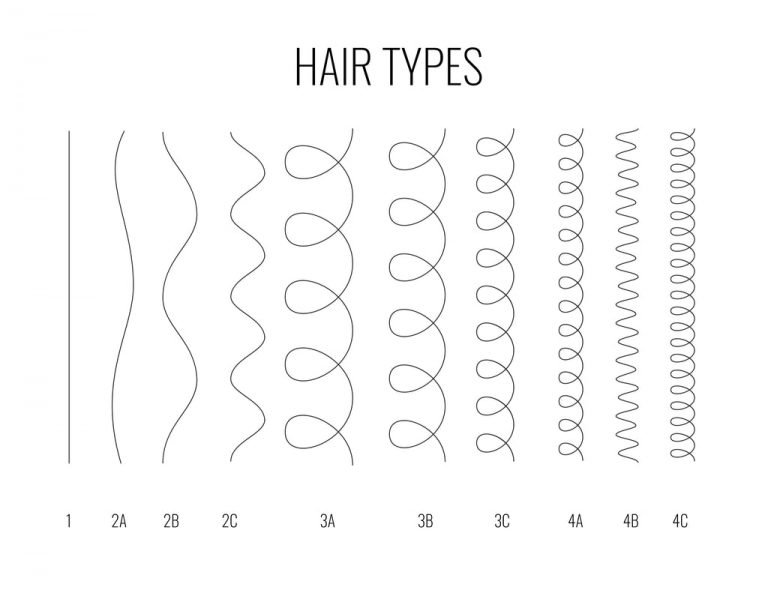
Straight hair is pretty much the same from one head to the next, although the hair’s thickness can differ drastically. Curls, on the other hand, are a different story. Curls can range from soft, loose waves to ringlets to kinky, super tight coils (that are so tight it’s akin to a workout to smooth them). Du says there are significant differences between wavy, curly, and coiled hair. “Curly hair makes a full 360-degree spiral, forming a complete circle where it twists, wavy hair is more of an S-shape that goes from side to side and coiled hair has tight curls in a zig-zag pattern from the scalp.”
You can gauge the degree of curl pattern in your hair by looking at its formation. Straight hair is type 1, wavy hair in a loose “S” pattern is considered type 2, type 3 curly hair is a loop or spiral pattern and type 4 hair is a compressed “S” or “Z” pattern, according to Godbee. From there, the diameter of the hair comes into play—the wider the hair, the looser the curl. The classification scale for curl thickness consists of type A, a wide pattern; type B, which is medium; and type C, which is the smallest of the three.
Now that you know what you’re working with, it’s time to use the right products for your curls. Using the wrong products can render the hair flat, too oily, or unmanageable. Here, a roundup of the best hair products for every hair type under the sun.